
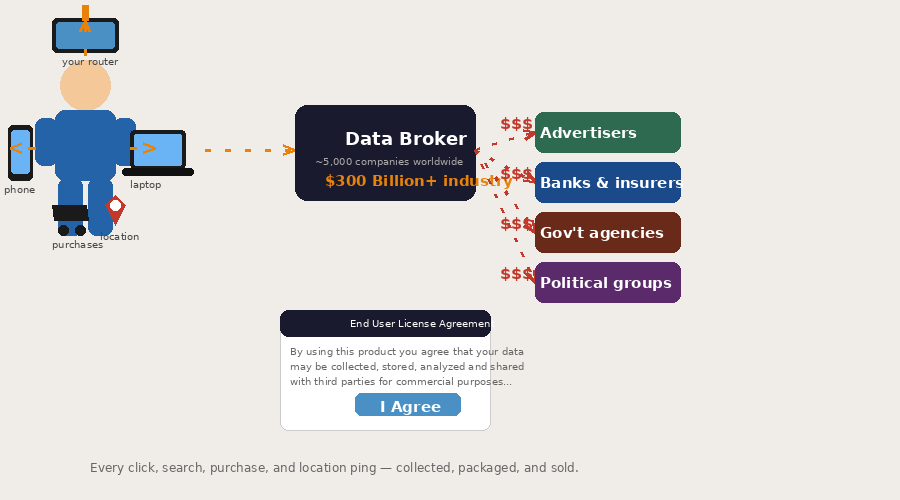
Data privacy wasn’t something most people thought about when they clicked “I Agree” on that ASUS router setup screen… Right there in the ASUS router setup screen: a box, some text, a button that said I Agree. Most people click it in under three seconds. Almost nobody reads it. And buried inside that agreement — and thousands like it — is the company’s right to collect data from your device, share it with third parties, and push software updates without asking you first.
Your router. In your home. Running 24 hours a day.
Why does a router company need your data?
They don’t need it to make your internet work. They want it because it has value. Your router sees everything on your network — which devices connect, when, what services they talk to. Across millions of households, that’s a detailed map of how people actually live.
But routers are just one small corner of a much larger system.
There is an entire economy built around data privacy violations — collecting your personal data and selling it. The data broker industry was valued at over $303 billion in 2024 and is growing at nearly 10% per year. There are an estimated 5,000 data brokers operating globally — companies most people have never heard of. Acxiom alone holds profiles on 2.5 billion consumers. Epsilon tracks 650 million people across 7,000 demographic and behavioral attributes. Yahoo FinanceMarket.us
They didn’t get your information by hacking you. You handed it to them — through every app you installed, every purchase you made, every form you filled out, and every device agreement you clicked past without reading.
What are they collecting?
More than most people expect. Age, income, education. Purchase history. Web browsing. Location data accurate to a few meters. Health signals inferred from pharmacy purchases. Social media activity. Property records. Voter data. Court filings. HIPAA protects medical records held by doctors and hospitals — but not prescription purchase history sold by pharmacies, or data from health apps. That gap is intentional and profitable. Grand View Research
Who buys it?
Advertisers are the biggest buyers, capturing about 36% of the market. But banks and insurers buy it to set rates. Employers use it for background checks. Political organizations use it to target voters. Government agencies have been customers too — Gravy Analytics sold location data to hedge funds, retailers, and government agencies before the FTC shut it down in early 2025. DEV CommunityGrand View Research
Since when?
The industry took shape in the 1990s when companies realized that digitizing public records created an inventory they could sell. The internet added browsing behavior. Smartphones added location. Smart home devices added the interior of your home. And the EULA — that wall of text you scroll past on every app and device — became the mechanism that makes it all technically consensual.
You agreed. It’s on page fourteen, paragraph six, subsection (c).
What data privacy actually costs you?
Because household behavior patterns are exactly what data buyers pay for. The firmware update clause means they can change how data is collected on your device later, without asking again. You already covered that when you clicked I Agree.
This isn’t unique to ASUS. Most major router manufacturers, smart TV makers, and connected device companies have identical terms.
The most unsettling part isn’t that companies collect your data. It’s that most people have a vague sense this is happening but have never looked at the actual scale — a $300 billion industry, 5,000 companies, billions of profiles, flowing quietly through the agreements you clicked past while setting up your devices.
Now you know what you agreed to.
Some states are pushing back. California, Texas, and several others have passed consumer data laws giving residents the right to request deletion of their information. The EU’s GDPR has had stricter rules since 2018. But with 5,000 brokers and a $300 billion market, regulation is still playing catch-up.
This is part of a pattern we’ve covered before — see The Subscription Trap and Your Car Already Has It.

